Home » Journal

Is your committee-run project like oatmeal?

Oatmeal, while healthy, is also an off-white blob composed of distinct particles loosely hanging together by a gelatinous substance.

Sounds wonderful, right?

Now picture a real meal, a dinner plate with a juicy seared steak surrounded by roasted potatoes, sautéed greens and wild mushroom compote.

They’re all in it together but the steak is the meal’s leader. The steak wouldn’t be as effective without its supporting cast. A one-person-led project can work, but it can also lack the pizzazz and ideas that a group of people bring to the table, each with their own perspective and expertise. (Assuming the team was  selected to create a balanced and broad understanding of the subject at hand.)

But the problem with teams is that many are unfocused and lack a real decisionmaker — someone who can keep the project alive with decisiveness.

How does indecision kill your efforts? Read more

Remembrance: A Paste-up + Mac Mashup

Way back when, in the days of t-squares, triangles, waxing machines and lots of bloody X-acto cuts, I met my first Mac. The year was 1987. I was a design student at the University of Maryland.

I had a paid internship in the university’s publications department where I spent the next six years. And this is where I met the Mac Plus. Introduced in 1986, the Mac Plus was the third in its line and cost a whopping $2499. It had a 9-inch monochrome display and a resolution of only 512×342 pixels. Typography was still fairly crude but far better than what the PCs in the school’s lab could do.

In our design program, there was one lab with a few PCs and crude paint software. And yet, to draw a squiggle on the screen felt like magic. Not many students took interest in these computers. Our projects required clean typography. One way to do that was to trace by hand and paint with gouache. Yes, we actually hand-painted our type, mainly headlines, but if you were insane enough, small type as well. I was insane and also poor.

Students who were bankrolled by parents could afford INTs — a type of transfer like a custom Letraset. We gouache types felt superior in our willingness to hand-craft our type, but really we were just jealous. And yet, even though this was painfully slow, we knew we were developing an intimacy with letterforms, drawing and spacing them just so — a skill that comes in handy even now because out-of-the-box type often requires some manipulation.

I digress, but it’s important to put this into context. For one thing, phones were still largely connected to walls (younger readers take note). There was no free music on the internet. There was no internet, at least for common folk.

I had never seen a Mac and I’m not sure I had heard of one.

I don’t recall why but I understood that this computer was cool. Probably because our boss would allow only certain of us to touch it. It sat unused much of the time because A) is was very small and hard to do a newsletter layout with it, and B) we weren’t yet able to output camera-ready layouts. We still hand-specified our manuscripts, sent them to a typesetter and used cave-man like tools to put a layout together.

There was also no such thing as halftones on the computer. In fact, it would take a few versions of the Mac before we stopped making halftones in a dark room (oh, the drudgery) to mash up with our computer-created layouts. Back then, we knew we were a little slow to adopt all the technology. Our new boss was resistant to the computer and discouraged us from using it fully, much to our annoyance.

Steve Jobs’ story of how typography came to the Mac is well-known. But for those who don’t know, he had taken a random calligraphy class at Reed College because he had seen beautifully done posters around campus. He spent hours learning about letter and word spacing, thinking he was just killing time and having a creative outlet.

“None of this had even a hope of any practical application in my life. But ten years later when we were designing the first Macintosh computer, it all came back to me, and we designed it all into the Mac. It was the first computer with beautiful typography. If I had never dropped in on that single course in college, the Mac would have never had multiple typefaces or proportionally spaced fonts, and since Windows just copied the Mac, it’s likely that no personal computer would have them.”

—Steve Jobs

Steve also said he wanted to put a “ding in the universe.”He certainly did that. And he also put a ding in people’s hearts.

(Image Credit: Blakespot / Flickr)

Do You Call Yourself an I or a We?

As an independent professional, you’re faced with whether to call yourself “I” or “we.” The alternative is to use only a company name and risk producing awkward copy for your website. Awkward, because when you don’t feel comfortable owning that you’re an “I,” but don’t want to claim you’re a “we,” you end up with passive language or other clunky constructions. Worse, you simply can’t express some ideas using only a company name in your verbiage.

I’ve gone back and forth on the issue. I’m coming down on the side of being an “I.” I really am an “I.” I don’t become a “we” because I extend my services by working with other professionals. Not in a true sense, unless this happens on every project, which it doesn’t. Some who all themselves “we” when they’re really an “I” might have a good rationalization. It makes me squeamish so I’ve always avoided “we,” and, well, have a hard time describing my services and client case studies with ease and clarity. Read more

Selling it, kid style

I live in a neighborhood of budding young entrepreneurs, which might be due to the socio-economic status of the parents. But as I take my daily walks, I get the shake down from five-year-olds who can barely talk but who can, at least, point to their wares such as five-cent, hand-painted popsicle sticks. I need to start carrying change with me. It’s hard to say no to a girl in Juliette-inspired dress with a lisp and waving a wand.

Fortunately, there’s no organic lemonade. Stands are, if admirably solid, still lacking polish, making them more appealing than if they looked as though an over-achieving parent had slaved to craft a mini Starbucks.

These kids have a natural business savvy. Many of us business owners bang our heads trying to figure out how to convince someone to hire us or even what specifically we sell. We look for just the right persuasive words. We wait to till our message is perfect before putting it out into the world. Only perfect never comes.

The most basic things really work:

• Meeting people where they are

• Delivering good service

• Being enthusiastic about your product or service

• Having a niche (lemonade or rocks or popsicle sticks, not all three)

• Create incentives to keep them coming back

On the way back from the market one day, I came across three boys. “Rocks for sale!” the youngest one yelled as he ran around a tree. “Spend five dollars and you get a coupon!” he shrieked.

A coupon for what, I asked the little boy. A coupon for more rocks, of course.

These three boys had a relaxed moxie and an air of confidence about their product, of which I found myself almost envious. A particularly interesting fossilized shell would set me back $1.50. I offered a dollar and they accepted—a little too quickly; their only weak point. But then I found a bright pink polished beauty that was only fifty cents. Still, I offered the dollar.

“I guess that makes me a pretty stupid customer,” I said.

The bouncy little boy yelled a little too loudly, “No it doesn’t. It makes you a smart customer!” He couldn’t say why when I asked him, but his sureness won me over and I was satisfied with being a smart customer.

No wonder they’d managed to amass over forty dollars in a few days. Fortunately, I’m not trying to sell rocks because the competition is stiff down the street.

Give a Man a Bowl of Pasta…

…and you feed him for a day; teach a man how to make pasta and you feed him for a lifetime.

Second only to enjoying a bowl of steaming pasta is the pleasure of making your own, which is what five people did here last Sunday. It does involve work. But as several of them said afterwords, “This was easier than I thought it would be!” This was my thought, too when I learned to make several hand-formed pasta shapes at a cooking school in southern Italy. Read more

Crowdsourcing and The Tyranny of Choice

A wave of admonishment ran through the design world recently when the Department of the Interior (DOI) used a popular design crowdsourcing site to solicit ideas for a new logo. (You can read petitions and arguments here and here.)

It raises the hackles of designers when high-profile organizations (last year it was the National Endowment for the Arts) use the design equivalent of trolling—capturing everything in its indiscriminate net for very little investment.

There are a number of unsavory aspects to this practice, but most importantly, the client doesn’t benefit.

It is a terrible waste of time for a company.

Even though I wanted to ogle the submitted design work, my head spun to take in all those solutions (600+), many of which were inappropriate or just plain bad. There is much to say even about the creative brief submitted by DOI, but I’m focusing here on the cost to the organization.

Faced with too many choices, we reach an overload and we fail to make good choices.

Many books have been written on the subject of choice and decisionmaking, and there is science that supports the conclusions about the impact of too many choices. Armed with a little bit of knowledge from some of these books, we can all make better choices and decisions (see list at end of post).

In his book, Paradox of Choice (affiliate link), author Barry Schwartz talks about the pitfalls of too much choice. (You can also watch his TED talk on the same subject.)

“All of this choice has two effects on people. It produces paralysis rather than liberation. The second effect is that even if we manage to overcome paralysis and make a choice, we end up less satisfied with the result of the choice than we would be if we’d had fewer options to choose from.”

The fallout from these two key effects of the staggering choices in today’s world manifests itself in more ways. There is an inherently lower satisfaction level which causes us to regret our choice more. It makes us imagine that there had probably been a better choice. And this regret makes us even more dissatisfied.

More options also creates higher expectations, simply because of the sheer number of choices. Faced with many options, we’re convinced we can pick the best one. The final blow to our happiness in our choice when we have many options, as opposed to fewer, is that we tend to blame ourselves for our lousy choice.

Suddenly, your job, which was probably already taxing just got taxed further.

One of the reasons Trader Joe’s is so successful and popular is that they limit the choices. They are aware of how a mindboggling array of choices affects our ability to choose and be satisfied. Think about the last time you stared openmouthed at the cat food or cereal shelf of a grocery store. You sigh, your shoulders sink and you tire just thinking about making a choice. There is a cognitive cost exacted with this type of decision.

……………

In the case of a crowdsourced logo, many organizations lured by almost free and hundreds of choices don’t take into account the massive cost of staff time to adequately evaluate the choices. The money they imagine they are saving will get spent on staff time probably better spent another way. Factor in the time lost on confusion and second guessing, and the cost is even higher. Now, instead of evaluating a few very solid solutions based on a really useful brief, you’re navigating through too many wrong solutions that make choosing harder.

This is why crowdsourcing design is fundamentally flawed. All the focus is on the form of the thing (its looks). Form is important. But the form is only a small part of an effective identity—strategy, appropriateness, uniqueness, flexibility, lasting power.

These same theories apply not just to crowdsourcing design work but also to soliciting too many bids (unless there is a requirement to do so).

It’s something to consider if your staff is already wearing too many hats, you’re concerned about cost (in a broad sense), you reputation to protect, and most of all, you want the quality of the output to match the level of the work you do.

There are two ways good ways to avoid all this. One is to be very clear about your goals, purpose, tone/personality, audience, uses and needs. And the second is to sharpen your skills and confidence in selecting and evaluating the right designer (or design team).

……………

Have you ever used a crowdsourcing site for design? Do you know anyone who has? If you’re willing to share your experiences, please do. There’s very little out there on what happens next.

……………

Books on decisionnmaking and choices

These are all excellent books on making both personal and business decisions. They cite similar studies but each book’s focus is slightly different. (These are affiliate links.)

The Art of Choosing by Sheena Iyengar

Paradox of Choice by Barry Schwartz

How We Decide by Jonah Lehrer

Predictably Irrational by Dan Ariely

…………….

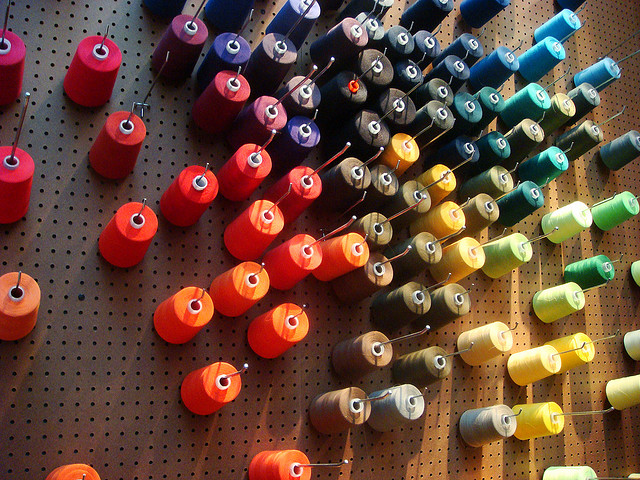
{Above: Creative commons image from “flickr/iamdonte”}